Quality
Material & finishing
The engineering behind our welding tables and clamping tools.
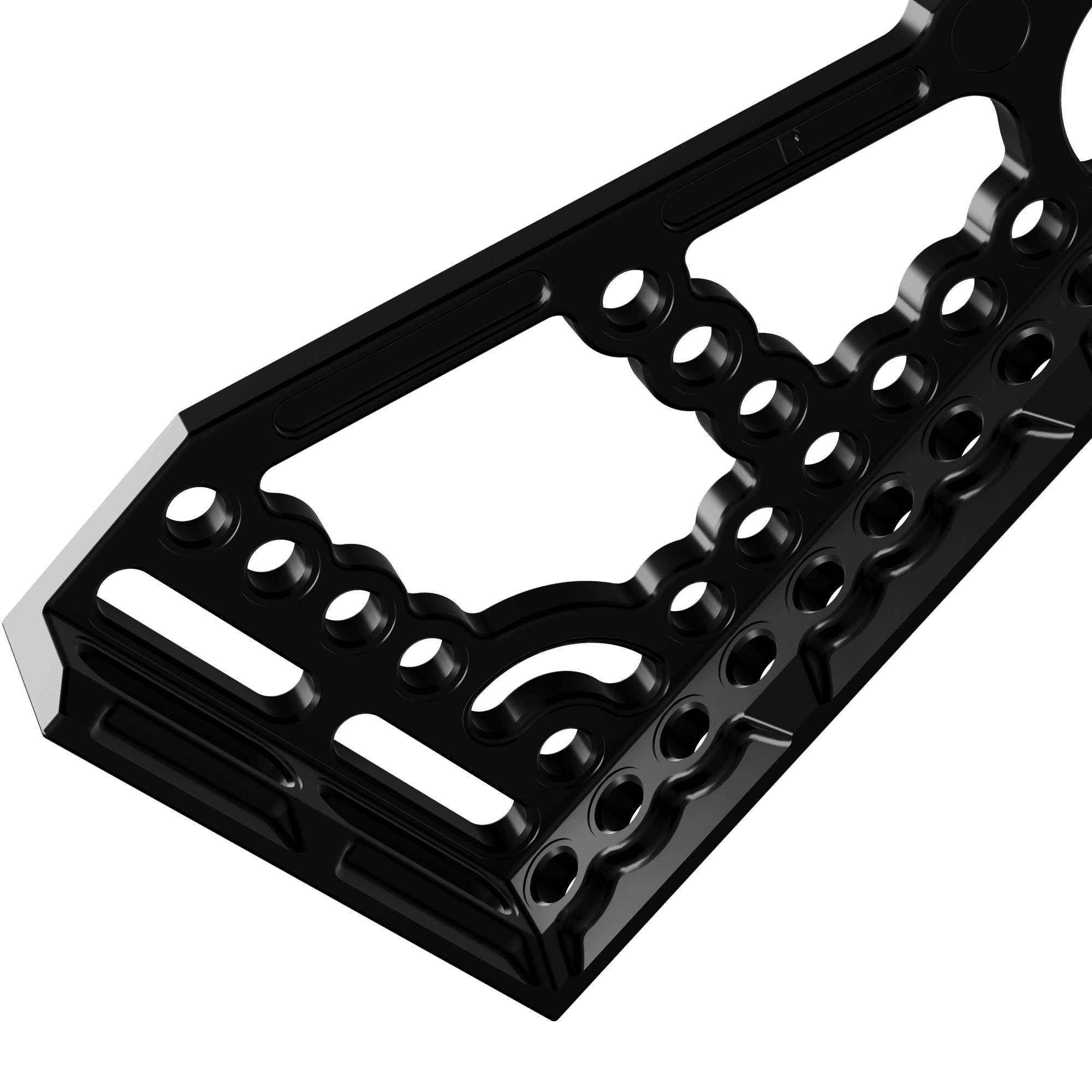
Material & machining
Steel & Surface Treatment
Our Ø28mm welding tables are manufactured from high-grade S690QL steel. After CNC milling, the tables are nitrided through gas nitriding, a thermochemical process that produces a deeper and more uniform nitride layer than many modern plasma processes. The result: a hard and wear-resistant surface with no additional coating, that is also corrosion-resistant.
CNC Milling
After welding, the tables are thermally stress-relieved to eliminate residual stresses. This is followed by 30 hours of CNC milling at 4x slower feed rate than standard, producing microscopically thin machining marks.
Gas nitriding
±90 hours in the nitriding furnace at approximately 600°C. Nitrogen diffuses through a special gas mixture deep into the steel: ±0.1 mm per 10 hours, up to 1 mm total. The steel grade determines the final result, S690QL achieves 800 HV surface hardness.
Result
All bore edges and corners are deburred with a precise radius. A hard, wear-resistant layer that cannot peel or flake off, not an applied coating, but steel hardened from within.
Clamping tools
Clamping Tools Built for the Shop Floor
Almost all our clamping tools, clamps, squares, stops and accessories, undergo a QPQ nitriding process for an extremely durable and wear-resistant surface. This produces a hard, corrosion-resistant finish that performs reliably for years. Designed for 28 mm welding table systems, fully compatible with Siegmund and with Demmeler except for the clamping bolts.
Reliable clamping
Workpieces stay precisely in position, even under repeated clamping, high clamping forces, and intensive daily use.
Repeatable positioning
Engineered for exact alignment and repeatable work within 16 and 28 mm fixturing systems. Ideal for batch production and complex weld assemblies.
Long tool life
QPQ nitriding ensures tools retain their dimensional accuracy and perform reliably for years, even under heavy industrial use.
Technical specifications
28mm & 16mm, all specifications
All tables are gas-nitrided. The Ø28mm system is compatible with Siegmund and Demmeler; the Ø16mm system suits lighter fixturing applications.
| Feature | 28mm – M800 | 16mm – M700 |
|---|---|---|
| Steel grade | S690QL | S355JR |
| Surface hardness | 800 HV | 700 HV |
| Nitriding depth | ±1 mm | ±1 mm |
| Bore diameter | Ø28 mm | Ø16 mm |
| Grid spacing | 100 × 100 mm | 50 × 50 mm |
| Compatible with | Siegmund, Demmeler | Siegmund |
Compatibility
16 and 28 mm systems
Our welding tables and clamping tools are available in 16 and 28 mm and fully compatible with the common systems from Siegmund. With Demmeler everything fits except our clamping bolts.
Frequently asked questions
Technical questions
Our Ø28mm welding tables are made from high-grade S690QL steel and gas-nitrided to 800 HV surface hardness. S690QL is harder and more dimensionally stable than the steel types commonly used by other welding table manufacturers, resulting in a table that lasts for years under heavy industrial load. All Ø28mm welding tables are the M800 version. We no longer sell the older M700 version in S355JR; M700 now refers only to the Ø16mm table (S355JR, 700 HV).
No. Gas nitriding is not a coating. It is a thermochemical process in which nitrogen penetrates deep into the steel at high temperature, hardening the surface layer from within. Nothing is applied to the steel. The result is a hard layer that is part of the steel itself: it cannot peel off, flake, or wear away like a coating.
No. Almost all our clamping tools undergo QPQ nitriding. This is a thermochemical process in which nitrogen penetrates deep into the metal and hardens the surface from within. Nothing is applied. The result is a corrosion-resistant, wear-resistant layer that is part of the metal itself. The specifications show which products are QPQ-nitrided.
Social media
See our products in action
We regularly post product videos on our social media. See exactly what our welding tables and tools look like, how they work and how they are made.